Recently the artist Ashley Bryan’s lifetime of extraordinary work was celebrated with the opening of a center housing his art (see http://ashleybryancenter.org/ ). To commemorate this, a really engaging, informative, beautiful exhibit of his work documenting it and his life was installed at the Blum Gallery at College of the Atlantic Blum. In the Human Ecology Core Course at the College in which I am one of the team teachers this fall, Ashley came and talked about his life and his work — and inspired us all in a host of ways. I have tried to capture some of the portion of that inspiration I received in the poem presented below — along with an audio version of it shared here — hoping it will encourage anyone not yet familiar with his incredibly life affirming art and children’s books to look them up as quick as they can 😉
”When Blackbird Came to Visit”
for Ashley Bryan
by Gray Cox
10/31/14
Blackbird came in.
He was full of color
Like a huge bowl full of M&Ms
Brimming over beneath a rainspout
That was catching all the brilliant candies pouring down
— pouring down in a shower of unending bounty
from the Goddess of Joy and Delight
who was splashing rainbows of excitement over every single one of us!
Blackbird said “Repeat after me!”
And then sang out loud as could be:
“My People are a Beautiful People!”
And suddenly we were all singing:
“My People are a Beautiful People!”
And all the colors of all our feathers
were touched and trembling with his inky black ,
And then we all sparkled like rainbows
Carved into a wooden block by a divinely inspired hand,
And that Blackbird, he was that hand,
Swirling in a dance as he lifted up his wings, circling into the sky,
To brush the tips of his wings around the edge of the Sun
And brush the tips of his wings around the cotton of the Clouds
And brush the tips of his wings around the edge of the Moon
— and he brushed his feathered back
all over the Night that was coming into the Sky
And it made the Stars sparkle twinkle beam
like the Eyes of Gods piercing through sea glass on a beach
that stretched out into the endless Ocean of the Night
— that Ocean of Night that was so full of color and so full of light
Because it was as Black and Beautiful as the Universe at its very beginning
when It was just a Baby about to Burst into Life.
And we all wanted to be born like that!
And grow up to be children just like that!
— Be Children Bursting with Life like Blackbird!!
And all we could think was: “Slap our Bottoms and Let’s Get Going!”
Looking to going to New York City this coming weekend for the big 350.org rally, I have been working on a song — and share it here with the words as well. The ideas in it relate, among other things, to those in earlier posts concerned with reducing consumption as well as dealing with climate change. Here is the song:
and here are the words and chords, which I hope folks will enjoy:
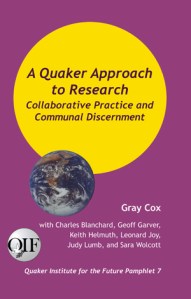
This summer I and a team of others from the Quaker Institute for the Future (QIF) published a new short book on Quaker approaches to research that draw on Friends’ traditions of communal discernment to enrich and frame investigations — including variations of spirit-led work that involves “meeting for worship for the conduct of research”. This work is available through mainstream online book sellers as well as through the QIF website at http://www.quakerinstitute.org/?page_id=5#pamphlet
The aim of this pamphlet is to describe 1) the vision, theory, and traditions of practice inspiring a Quaker approach to research; 2) experiments with specific methods used; 3) initial results and findings; and 4) the key challenges and puzzles that remain. It further aims to explore the relevance of Quaker process when the participants are not Quaker or even religious.
Chapter I begins with a description of the vision, theory, and tradition of practices that emerged among early Quakers in the 1600s and that have been refined and extended in a variety of decision-making contexts over the last 350 years. Chapter II provides a more detailed account of the procedures and practices with which QIF has experimented in its first ten years.
Chapter III compares other traditions with these Quaker practices of communal discernment in research, policy analysis and collective decision making. There is much to be learned through dialogue with other faith-based traditions. Further, it is useful to consider how Quaker practices may be usefully modified and adapted in secular settings.
Chapter IV explores some of the philosophical issues and challenges that are raised by the very idea of having a “Quaker Epistemology” or way of knowing and the distinctive assumptions made about the process of research, the norms and criteria for knowledge, and the nature of reality. Especially challenging are the historic splits that have been framed between church and state, and between faith and reason. This chapter does not provide final resolution to the important methodological and metaphysical issues raised but try to frame them in reasonable and useful ways to facilitate ongoing dialogue amongst Quakers and others, even ardent atheists.
Chapter V closes with some reflections on the future of collaborative and communal research.
I never quite know what I may find in unusual places — including watching TV 😉
After recently watching the Albert Schweitzer episode in THE ADVENTURES OF THE YOUNG INDIANA JONES, I was led to think about Schweitzer’s core principle of ethics — in ways that give echo to my own sense of what is expressed in a song of mine called “We All Come From Africa”. To listen to that song, click here:
What is “reverence for life” or what Schweitzer called “Ehrfurcht vor dem Leben”?
In English, “reverence” suggests church, it suggests being quiet, it suggest being very attentive to someone speaking from a pulpit or something being viewed in a museum or altar or judges bench by one of us congregated in the mass of the of common and mundane folk who get to view or hear the object of our reverence. And it suggests something framed not only by an altar or pulpit or exhibition proscenium but framed as well by one or more ideas – by intellectual and abstract principles or notions that we might capitalize like Beauty, Truth, Justice, God . . .
For a long time I thought of Schweitzer’s principle in this way. I admired it as a testament from someone who seemd to be an especially good man who had done heroic things with his life – risking his all (family, wealth, reputation, life . . .) to deliver desperately needed medicine to strangers in a strange and dangerous and distant land. But it seemed so abstract. And impossibly filled with contradiction – if I revere the life in the deer, how do I treat the wolf? Or the plants the deer eats?
And this came in part from the way I imagined Schweitzer coming upon the phrase and principle. He himself was a very gifted and well read intellectual and he himself spoke of a very intellectual process not that unfamiliar to me as someone who has worked multiple years on academic writings. In his autobiography “Out of My Life and Thought” he explains this process. Having described how at the beginning of the summer of 1915 he awoke from some kind of mental daze, asking himself why he was only criticizing civilization and not working on something constructive, he asked himself the question:
But what is civilization?
The essential element in civilization is the ethical perfecting of the individual as well as society. At the same time, every spiritual and every material step forward has significance for civilization. The will to civilization is, then, the universal will to progress that is conscious of the ethical as the highest value. In spite of the great importance we attach to the achievements of science and human prowess, it is obvious that only a humanity that is striving for ethical ends can benefit in full measure from material progress and can overcome the dangers that accompany it . . . The only possible way out of chaos is for us to adopt a concept of the world based on the ideal of true civilization . . . . For months on end I lived in a continual state of mental agitation. Without the least success I concentrated – even during my daily work at the hospital, – on the real nature of the affirmation of life and of ethics and on the question of what they have in common. I was wandering about in a thicket where no path was to be found. I was pushing against an iron door that would not yield.
But recently I entered into Schweitzer’s experience and thought in a different way.
I imagined him not as the German Philosopher but as the medical missionary, working out of a hut in Africa surrounded by teeming jungle and on the edge of a great flowing river. I invite you to see him this way. He is a doctor who has been saving lives, tending bones and flesh, watching it heal of itself in miraculous ways, traveling in a vast wilderland with teeming trees bushes and birds and animals, traveling along the river . . and the motor cuts out . . . the boat sits quite in the flow of the river . . . and suddenly he stops listening to his own furious intellect and openly attends to the life around him . . . he can hear the silence of it and then, the Presence of all that life around – in the water where fish are swimming with crocs and hippos, at the bank where herons wade and grasses grow, in the trees where monkeys call and the bushes where birds flit about (not like ideas read in a poem by T. S. Eliot but like real birds in the bush over here, now) and he sees the child sitting on its mother’s lap on the boat – the child whose birth he witnessed as an incredibly complex process of brains and hips and bones and muscles and lungs and contractions and shouts and spreading of one set of legs to make room for another’s and community cooperation in choosing partners and cultivating care. . .
And he sits there, in awe, as a medical person, who can appreciate how unthinkably complex this whole jungle and river of life is . . . and that it includes him – he is a vital part of it all . . .
And the phrase “Ehrfrucht vor dem Leben” comes to mind to give that sense expression.
How to express that sense in English?
It is not like the tame reverence of a docile congregant attending an object behind a frame or proscenium.
It is the awe of someone being splashed by a Niagara Falls.
It is not the reverence of a person sitting meditating on an abstract Principle or Idea.
It is the rushing sense of enthusiasm and glory of you as an adolescent running out from school on a flush spring day with sunlight zinging through all the plants and birds chirping busily to nest and bees buzzing noisily in their honey-sweet acts of pollination and then your own jumpy urge to prance and find some sweet other to dance about with in the grass . . .
Perhaps we could agree with Wikpedia suggestion that: The phrase Reverence for Life is a translation of the German phrase: “Ehrfurcht vor dem Leben” (more accurately translated as: “to be in awe of the mystery of life”). [NOTE: this misses the import of “vor” which can mean because of or from – so it is something like awe or wonder from or at or because of life”]
A better writer could surely express it with even much greater power than that phrase does or than my writing here has managed . But I think that the key is not to find a piece of writing somewhere in this text or some other that describes the feeling. The key is to have it. To go forth and feel the life pulsing in your veins and that of the others – every person, plant, beast and organism on this wondrous planet.
And when you feel that . . . then it will be time to consider how best to deal with haovc of Global Warming or grinding away at life with asphalt and cement and inorganic chemicals or the possibilities of future Silent Springs.
This is a talk I gave recently at the Point of View Conference: “Ethics, Conflict and Resolution” at George Mason University, February 15th, 2014
“Reframing Ethics Itself in a Conflict Resolution Paradigm”
“Mainstream ethics” is nicely illustrated by one of the most popular courses taught at Harvard, Michael Sandel’s “Justice”. Like other courses in ethics it introduces students to theories through applications to difficult cases, typically dilemmas, in which significant – often life and death – decisions must be made. The paradigm of reasoning adopted is modeled loosely on mathematics and natural science in that it is supposed that given one or more basic axioms, like the CI or GHP, and some specific conditions of the case, a single person acting as a judge or agent can infer what the correct choice would be. Such an approach is “monological” precisely in the sense that it assumes that given the principles and specific conditions, one person can determine what is the ethical thing to do. No dialogue is necessary. Unfortunately the quest for an ethical theory that can really serve this role has been profoundly frustrating to philosophers and their students who find themselves left with self-contradictory theories, conflicting intuitions, ad hoc solutions, and the increasingly desperate sense that the plague of relativism will doom all our best efforts.
A clue to an alternative way of conceptualizing ethics and its pedagogy is provided by the first episode of Sandel’s course broadcast on Youtube. In the dilemma it presents to students, they are asked to suppose they are a doctor with six patients, five of whom are each in need of a new vital organ to survive. The sixth is a perfectly healthy patient with all five needed organs — in for a check up currently unconscious, napping in the next room. The doctor is asked to consider harvesting organs from the healthy patient to save the others. The pedagogical point here is, in part, to push students who had been favoring a strict Utilitarian ethic to consider if their intuitions would indeed lead them to promote the greatest happiness in this case by sacrificing the one for the many. Interestingly, one student proposes an alternative answer. He says he would harvest organs from one of the five patients already compromised to provide for the other four – since that victim would have died anyway, given the suppositions of the case. The flow of Sandel’s pedagogical process is briefly disrupted by the sustained applause for this suggestion. Smiling, he comments that: “That’s a pretty good idea. That’s a great idea except for the fact that you just wrecked the philosophical point.” And then he redirects the discussion. In doing this, Sandel is, of course, following a standard approach in mainstream ethical pedagogy of pushing students to confront the hard cases through maintaining their formulations as dilemmas.
But think about this for a moment. If one of your students comes up with a way of making an ethical dilemma go away, isn’t that precisely the sort of thinking you would want to encourage? Of course there may still be value to the study of dilemmas to hone judgment and clarify concepts BUT it would seem that the larger frame we should adopt in thinking about ethics should be the one Sandel’s student implicitly was adopting – that of negotiation, group problem solving, conflict resolution and transformation. What are the central features of ethics if it is reframed in that way?
1 . Instead of supposing ethics should provide a monological decision procedure for ethical judgment, we should view it as a dialogical process of negotiation, group problem solving and conflict resolution for arriving at agreements. 2.) In seeking objective values to guide our pursuit of agreements, the conception of objectivity should not be that of the sort sought in math and physics with its absolutist view of truth as that which is invariant — universal, exact, and eternal. Instead we should seek truths that are objective in the sense of being more impartial and complete but which are contextualized, approximate, emergent cross-cultural and trans-historical truths. 3.) Instead of grounding ethical analysis in a “golden rule” that advocates some form of universal principle (as interpreted in either Utilitarian or Kantian ways), we should ground ethics in a principle of diversity, a kind of “rainbow rule” that advocates “doing unto others as they would have us do unto them”. 4.) The epistemological and metaphysical approach to understanding respect for persons and related values such as human rights should be interpreted in ways developed by Martin Buber and Gandhi in his practice of satyagraha – as emergent values that are demonstrated by non-violent witnessing rather than absolute values that are demonstrated by logical proofs. 5.) Limiting cases where dialogue breaks down will need to be ever watched for and struggled with, cases in which the incapacities of some participants in a situation make it impossible for them to engage effectively in dialogue and cases in which the power imbalances present enable other participants to refuse to listen. We have to be ever wary of when the moment has come to set aside conflict resolution skills for the moment and intervene on behalf of the disempowered.
Let me elaborate on each of these five points.
First, to say this paradigm frames ethics as dialogical rather than monological is to note that the aim is to talk and interact back and forth with others until some form of shared consent is achieved. The outcome cannot be defined ahead of time by any single party to the dispute. In this way it is quite different frm the model of ethical judgment that typifies mainstream ethics in which the courtroom and, in particular, the decision of a judge, is viewed as the paradigm. Further, while the process can make use of insights from formal game theory, it can not be formulated as a decision procedure coded in an algorithm that would be calculated by one “player” or party to the dispute. This is because negotiation and conflict transformation practices of dealing with disputes emphasize creative initiatives in which the terms of the conflict are redefined and transformed – by revising participants understandings of what their real interests are, what options may be available, what criteria might be appropriate for assessing them, et cetera.
What notion of objectivity is appropriate for this way of framing ethics? At the very core of the concept of objectivity is the notion that there is something that is true independently of me and you and our individual or community beliefs. Mainstream ethics has sought a version of this modeled on math and physics – objective truths that would be absolute and invariant — universal, exact, and eternal. But earth science, biology and history provide a different notion of objectivity more appropriate to ethics: the objective as the less one-sided, the more impartial, the more complete understanding of what is true, independently of our beliefs. The shape of the earth, the evolutionary origin of humans, the history of the modern market system – these are things which are real and objective but not universal, absolute or eternal. Instead, as realities, they are embedded in contexts, filled with grayish border areas, and emergent. Like the knowledge of them, knowledge of objective truths in ethics takes the form of contextualized, approximate, emergent cross-cultural and trans-historical truths. One brief example of this which I hope might be suggestive is Aldo Leopold’s in “The Land Ethic” in which he argued that our understanding of who or what should count as a member of our community has changed – growing from the inner gang of Princes like Agamenon and Odysseus in the Iliad to include the hoplite warriors of Athens to later include slaves, women, other races and even now other species and the whole of the ecological community on this planet.
Many have argued a key candidate for such an emergent objective value would be some version of the Golden Rule which is found in many cultures and which Utilitarians and Kantians have claimed as a core original insight that is best articulated by their particular theories. The traditional version can be stated as: “Do unto others as you would have them do unto you.” This makes sense if you are dealing with your neighbors — and you and they are part of a homogeneous community. But otherwise, this Golden Rule would seem to invite ego-centric and ethnocentric behavior that ignores the often very legitimate values and points of view of people from other conditions in life or cultural traditions – just as so many nineteenth century missionaries seemed to have done in promulgating the Golden Rule and the Christian Faith throughout the world. Flawed as they are in their powers of articulation and limited as we are in our powers of listening, it is still true that in general the best resource we have for figuring out what other people want is to ask them. And the best rule for taking their concerns into account in any situation is not to “Do unto others as I would have them do unto me” but, instead, to “Do unto others as they would have me do unto them.” This second rule is one that recognizes and embraces the diversity in the world. It might be called the “Rainbow Rule”, in that sense. It is a “rule” that is widely applied in successful ways by wise people in settings where there is considerable diversity in the interests and outlooks of people involved. . It fits us to love not only neighbors like us but enemies who are quite different.
Mainstream Ethics
Alternative Paradigm
1. Model of reasoning:
Monological
Decision procedure
To arrive at judgment
Dialogical
Negotiation & problem solving process
To arrive at agreement
2. Objective truth as knowledge of a reality independent of our belief and:
Absolute, Invariant
Universal
Exact
Eternal
Impartial, more Complete
Contextual
Approximate
Cross-cultural & Trans-historical
3. Reading of core Judeo-Christian tradition:
Golden Rule: Do unto others as you would have them do unto you.
(love of neighbors)
Rainbow Rule: Do unto others as they would have you do unto them.
(love even of enemies)
4. How the value of persons exists and is known:
Absolute reality known by
Deduction and argumentative proof
(Kant)
Emergent reality known by witnessing through non-violent methods such as dialogue and satyagraha (Buber and Gandhi)
5. Limiting cases for ethical relations with others:
In principle none should be allowed because the theory sought is universal.
When dialogue is not possible and another kind of intervention is called for.
Respect for persons is a further candidate for an objective value, used to undergird our understandings of human dignity and human rights, for example. Despite the fact that it is articulated in different nuances it seems to have a common core that is embraced across many different cultures around the world. And yet philosophers have found it extremely difficult to provide a logical deduction of the foundations for it. Why? Because, I suggest, such a value is objective in the sense of being an emergent truth which is appropriately demonstrated not by logical deductions of the Kantian kind but by the nonviolent witnessing that Buber and Gandhi practiced – engaging people in dialogue that draws them into I/thou relationships, witnessing to our own sense of a truth that we are ready to hold fast to in a self-sacrificing “satya-graha”. Philosophical analysis can help us understand our concepts of human dignity – but the value of it is something that is not proven via logic but known directly by experience.
Of course there are times when we encounter humans who are unable to engage in dialogue – or who are in positions of power that enable them to choose to not enter into I/thou relations with the people who are objects of their oppression. In such cases, the methods of dialogue and satyagraha may reach their limits – and we need to be ready to shift to other forms of advocacy and action – just as the wise teacher knows that bullying on the playground may sometimes need to simply be interrupted and the wise divorce mediator knows there may be times when, because of power imbalances, mediation needs to stop and another kind of intervention should begin.
In general, I want to suggest the dialogical paradigm I have sketched here should be used to frame our teaching, research and action and that we should work to elaborate it more carefully and systematically than I have been able to here. Thanks!
I was delighted to take part in an Earthday Conference organized at College of the Atlantic on the theme of “Cooperation, Community and Complexity.” (For more on it and the very interesting presentations it included see: http://coa.edu/ecocon). As part of it I presented a short talk focused on a proposal to cut U. S. citizens’ consumption dramatically and quickly. The bullet form of the talk is included here. Comments growing out of the discussion it sparked will follow.
“Meeting the Future Halfway: Seeking An Economical Sound and Politically Effective Way to Cut US Consumers’ Ecological Footprint in Half Over Five Years”
My goal today is to foster a conversation about our patterns of consumption. But being caught up in the busyness of the world and consumption of ideas as well as things, I hope you will permit me to slow myself down a bit to enter this conversation with a prelude, a song. You can listen to it here: Here are the words:
I’m gonna slow right down, so I can get there sooner.
I’m gonna slow right down, so I can get there today.
I’m gonna slow right down. Maybe even come to a full stop.
Maybe if I come to a full stop, I’m gonna get there right a way.
Some assumptions:
a. If everyone were to consume at the average level of the US consumer, we would need four planets or more to sustain ourselves. So the future is one in which the average person on the planet will consume, in material resources, ¼ or less of what the average U. S. citizen does today.
b. 3 of the 7 billion people on Earth live on $2.50 a day or less – which is way too little.
c. Dealing with the ecological problems and the poverty problems will require major changes in the ways our economic system invests and the ways power is exercised in our political systems.
A basic proposal to address these concerns:
One simple action people in the U. S. might consider taking is to adopt a plan to cut our consumption by 10% this year – and 10% the following year, and %10 more the year after that until, at the end of five years, we will have cut our consumption by %50. We can take the remainder of our income and spend it either on direct aid to those in need, on political efforts to change the world or on investments in natural and community capital that will restore and enhance the earth currently being destroyed.
This action is simple in that sense that the basic step to be taken is relatively clear to understand and justify – though like any clear and reasonable action it requires appropriate application to the specific circumstances of peoples’ lives. The action is also simple in the sense that it is a step towards simplicity of living – though like any simplification of life, it can involve a subtlety and complexity of sensitive understanding. It arguably does not go far enough towards the future we need to reach. But perhaps we can think of it as a starting point which begins to address the problems of ecological impact and poverty in an integrated way as socio-political economic actors – providing a way to meet the Future halfway. (And then see where we go from there.)
One further key point to note: Unlike some other proposals to cut consumption, this one does not reduce aggregate macroeconomic demand and would not present a threat of recession, depression and downwards spiral of the economy. In Herman Daly’s terms, it would provide a way to continue economic “development” while quickly and significantly reducing and reversing material “growth” and downsizing the ecological impact of the U. S. economy.
What might motivate people to undertake this action? And to what extent?
a. Ethical concerns for other people and/or the environment
b. Religious motivations (for a version of this paper presenting these ideas in a religious context see my paper from FRIENDS JOURNAL on “Meeting God Halfway” which is available at: http://www.quakerinstitute.org/?page_id=71
c. Desires to become owners through investment
d. Desires to become powerful, politically
e. Desires for security by reducing needs and increasing resources
f. Desires for “simplicity” of lifestyle and attendant peace, health or other effects
g. Incentives introduced by community, state or national policies
h. Shifts in identity and culture brought about in any number of ways — as with the example of energy consumers in Hancock County who have shifted from using oil or gas as “Modern Consumer Families” to being “Self-reliant Downeast Yankees” who use locally sourced wood. (For more on this case study, a paper is available by request.)
Some puzzles about the proposal that need to be thought through further:
a. How should we measure and count personal income and consumption as a percentage of family expenditures – vs. government payments, aid to others, socially responsible investment and political action – and insurance, decisions to pay extra for “green” products, et cetera?
b. To what extent should we encourage reaching the 50% figure by increasing income instead of decreasing consumption?
c. To what extent and in what ways is a gross measure of consumption a useful and appropriate measure of ecological impact for the average citizen to gauge his or her footprint or, perhaps better labeled: “bulldozer print”?
d. How should the proposal be adapted to people in different life circumstances – ages, family units, starting levels of consumption, et cetera?
e. How to make the transition at personal level?
f. How to best scale up the transition – and deal with possible dislocations in the political economy?
I hope conversation around this proposal will continue not only amongst ourselves now and later in the day and beyond, but amongst others. I am hoping in particular it might continue through a blog at: http://breathonthewater.com
To spark such discussion, I invite you to consider how you would choose between one of four possible career scenarios that you might adopt over the next 20 years. The scenarios assume, for simplicity’s sake, that you will make on average $50,000 a year, that in every case, if you save income to invest you will do so in a socially responsible form (e. g. investing in alternative energy or organic farms or local education bonds) that return a rate of 4% per year, and that in every case you will save at least 5% a year for a retirement fund of some kind. The choices are, then, to:
A. simply consume the rest of your income each year in the amount of $47,500 (a bit like the “Grasshopper” in the fable by La Fontaine)
B. live on $25,000 of consumption a year and spend 45% of your income on helping 25 people in absolute poverty living on $2.50 a day to double their income (the “Samaritan”, option B) by giving $22,500 a year.
C. live on $25,000 of consumption a year spend 45% of your income in the amount of $22,500 a year on political action like electing funding a state legislator’s campaign or lobbying Congress (the “Political Activist”) – and it is assumed that you will be able to get at least 10,000 people through some group like Moveon.org to join you in this so there is a multiplier that results in the collective financial impact of your group on politics in the amount of 225 million dollars a year
D. live on $25,000 a year and invest an extra 45% (for a total of 50%) on socially responsible things like organic farms, alternative energy, etc. (the “Socially Responsible Ant”) – while A, B and C save only 5% a year and end up at the close of the 20 years with a little over $76,000 the “Ant” will have savings equal a bit more than $764,000. In that case, you will be able, at the end of the 20 years to retire with an annual income from your investments at 4% of around $30,000 a year.
Below is a chart summarizing these four options. If those were the choices before you for your next 20 years, which would you choose and why?
A
B
C
D
Grasshopper
Samaritan
Political Activist
Socially Responsible Ant
1
income
50,000
50,000
50,000
50,000
50,000
2
investment rate of return
0
0.04
0.04
0.04
0.04
3
investment rate
0.05
0.05
0.05
0.50
4
annual investment
2,500
2,500
2,500
25,000
5
annual giving rate
0
6
annual political $ rate
0
7
years worked
20
20
20
20
8
annual spending on personal consumption
47,500
25,000
25,000
25,000
9
personal wealth accumulation in socially responsible investment
I recently had a wonderful experience sharing a weekend of worship, workshops, songs and reflections with Quakers in Bruceville, Texas, gathered there for the 2013 South Central Yearly Meeting on the theme: “Lead Kindly Light: Being Faithful”. I had been invited to give a keynote talk and found it led to some reflections which I would like to share here on: “Sharing the Spiritual Commons in a Culture of Peace and a Political Economy of Democratic Stewardship”. They concern two great challenges I think Quakers and others face in trying to live out the their testimonies — and some practical responses. The first challenge is to transform the dominant culture of conflict into a culture of peace. The second is to transform our political economy from a plutocratic national security state seeking ever more GNP into a human development driven democracy practicing ever better stewardship of the commons. I framed these challenges with some preliminary reflections on the Quaker experience at the heart of all the testimonies, the experience of the Inward Light or Truth which is the Spiritual Commons from which all the testimonies spring and to which we are called to be as present and faithful as we can be. The full text that I prepared is available here: graycoxscymkeynote
I am helping Ed Snyder and Ron Beard to teach a course on “Moral/Social Evolution” at the Acadia Senior College in which we are asking whether or not Martin Luther King was right in saying that the “arc of the moral universe is long but it bends towards jusice.” In preparation for the session on “Religion” and the “arc of the moral universe”, on participant asked, from the point of view of a non-believer, why there are religions. What leads people to have them? (Perhaps, especially, in light of all the problems they can give rise to.) Here are some initial reflections on this:
Note that it might be useful to first distinguish religious institutions – like the Catholic Church – from spiritual experiences which get interpreted and sometimes packaged or promoted by such institutions.
Reasons why there are religious institutions could vary widely but might include all the ways they might serve like, other insitutions, to coordinate society – but be distinguished by drawing especially heavily on “charismatic” and “traditional” forms of legitimacy. (cf. Max Weber). They might also serve, in many cases specifically to interpret, package and promote spiritual experiences that people might often have independently of their existence.
Some possible sources of “spiritual experience” in the broadest sense of the term:
1. Fears and desires in the face of the enigmatic environment – superstition, manipulations (theories of animism and religion as a kind of primitive science – cf. E. B. Tylor http://en.wikipedia.org/wiki/Edward_Burnett_Tylor#Religion_as_a_survival
2. Anxiety or dread (Angst) as a structure of human existence – cf. Soren Kierkegaard’s THE CONCEPT OF DREAD, Martin Heidegger in BEING AND TIME and the Existentialists
3. A variety of feelings and experiential states that are different from the banal experiences of instrumentally organized everyday life – dreams, hallucinations, déjà vu, the calm of alpha brain waves, the exhiliration of adrenaline, dopmamine or other chemicals. These can take many forms and have led to all sorts of animistic and polytheistic religions
4. oceanic feelings of joyful merging with the environment that might motivate monotheistic spiritual visions and religions – from drugs, from chasms, from spinning,, memories of the womb? – keyed by molecules (cf. Freud THE FUTURE OF AN ILLUSION and CIVILIZATION AND ITS DISCONTENTS)
5. oceanic thoughts of being a text in an overwhelming and infinite context – from meta-reflection, which comes with language as a distinctive exaptation or spandrel of natural selection. (see the history of western philosophy from the Pre-Socratics on as well as other traditions on the “meta” basis of this and see Stephen Jay Gould on the biological basis in exaptation and spandrels http://en.wikipedia.org/wiki/Evolutionary_psychology_of_religion .)
a. E. g. who is the I that thinks about me and wonders who I am? Or the we?
b. What is the biggest number? Or the first cause? Or the justification for the justification? Or the next why? Or what happened on the day before time began?
6. Reciprocities of love – the transformation and transcendence that provides the experience of becoming more, by listening and joining with the other in a larger community and identity – parent and child, comrade, couple, community . . . in mutually constituting relations of I and You (cf. Martin Buber on I AND THOU)
a. Including the feeling of freedom
b. And transcendence
c. And being affirmed and loved
d. Versions of these expressed in rationality and ethical principles like Kant’s Categorical Imperative as a demand that we will only those actions that we could will universally, always considering everyone as ends in themselves and not as mere things – Many understandings of modern notions of justice including Universal Human rights are often strongly associated with some version of this rational notion of reciprocity and grounded in experiential levels in a, b, and c.
These sources of spiritual experience are all coded into our DNA and our ability to use language. In some sense there possibility must also be coded in the nature of reality, though what that means remains open to much debate. Materialists who are atheistic generally find it much easier to explain away religion by focusing on 1-4 and find #5 & 6 much more challenging to interpret – or dismiss.
An interesting question might be why don’t we experience variations on #4-6 more?
Perhaps because they make us dysfunctional as objects, as instruments, as machines. We are too creative to obey standard rules and be used for the ends authorities have. And so they teach us other languages and get us to stop spinning on the ground or staring down from trees, they make us stop asking why or wondering what the biggest number or first cause was. They put us to work and make us want to keep focused.
Most creedal religions are in fact part of a plan of life and action that standardizes behavior and removes us from the mystical and the revelatory. That is its function. It takes a dose of the awesome, oceanic love and Light and wraps it in Christmas or some other special space and time and tones everything else down.
It is the political economy that pushes us into conflict and out of love. And so we suffer. We view all of life as a conflict between two islanders over one coconut – or variations on that theme — and see ourselves locked in a struggle over fears and desires framed by an underlying dread of death. And religious experiences of types 1 and 2 predominate and those of 4-6 are obscured. We cannot even, in our mainstream society, very well articulate what real love is. (For more on this, see my talk given recently to the South Central Yearly Meeting of the Religious Society of Friends (Quakers) in Bruceville, Texas: “Sharing the Spiritual Commons”.)
A parade of Civil Society members walked out of the negotiation “Rio Centro” for Rio+20 yesterday, many of them abandoning their entrance badges, shouting “The Future We Want Is Not Found Here!” If you like sound tracks to hear while you read about such things, you can listen to one of the songs that was sung in Spanish by pressing here (translation provided at end of blog):
From their point of view, the results of the long negotiations by the nation states of the world have made essentially no real progress on the desperately urgent problems of the environment, poverty and justice — and have abandoned the core principles and the central social contract of the original Rio Conference. There, in 1992, a vision was framed for “sustainable development” in which the poorer and developing countries of the world would give up their right to pollute as much in the future as developed countries have in the past and present — in exchange for real and substantial aid in the technology and investment needed to develop in more sustainable ways. The conference this week should have been a time to celebrate the completion of the 20 years of negotiations to work out the details of that agreement and the financial commitments for its implementation. But the heads of state of the developed world have not bothered to come – to avoid the embarrassment of having no real commitments to announce.
The Civil Society walk out began simply as a staged press event in the middle of the walkways in front of the building where delegates enter for the negotiations. An enlarged copy of the negotiation text had been printed – with company logos from Monsanto, Coca Cola and others printed across the top announcing that this Rio text was the future that they “had bought” as corporations. A large crowd quickly gathered and lots of media as the text was symbolically torn in half. But then, instead of dispersing , the crowd’s passionate frustration with the Rio process and anger at the outcome gave birth to a People’s Assembly using the meeting methods of the Occupy movement.
And after two hours of deliberation, by consensus, those assembled resolved to stage the walk out, turning their backs on the negotiations. But it was, just as much, a walk towards something else: a march towards the Peoples’ Summit going on simultaneously in Flamengo Park in downtown Rio. There 20,000 or more members of Civil Society have been gathering this week to share the results of the incredibly interesting, successful and in many cases extraordinarily major efforts they have been making to promote just, equitable forms of development for those who need it in ways that are ecologically sustainable for all. There the “Rio” process is more than alive and well, it is thriving and giving birth to a new vision and a new world – a world governed by progressive cities and provinces, by community groups, by indigenous peoples, by alliances between businesses and non-governmental organizations, by women’s groups, by youth . . . by the people who are now have begun to take into their own hands the serious problems which the United Nations have proven incompetent to handle.
The message of the walkout was clear: The Future We Want Is Not In Here – in the UN negotiations – it is out there in the world of Civil Society and the Peoples of the world where the real Rio process is going on. The king has died. Rio is dead! Long Live Rio!
It is a hard story to report and it will take a while to get fully covered in the news because it is a story about a radical change in the way we will tell news stories about how the world is governed. The new “king”, or perhaps better, “queen”, of sustainable development is not one president or even a short list of nation states. And it does not govern in a single royal court or parliament. And it does not even have an army. But that is, in fact, the secret to its growing and dramatic success.
Sovereign nation states like the U. S. and China have a territory they defend with a military. As a result, they are pressed inevitably to look at the world in terms of “realpolitik” – promoting their national interests and guarding them from external threat. Every resource of the world inevitably appears in their calculations as a conquest, a possession either of theirs or another nation. The “commons” that we share disappear from view – magically, as if a wand were waved. Nothing looks like a commons a community shares – not even not the wonderful diversity of nature, no land, not waters, not even the air we all breath. They all look like possessions that belong to someone, commodities that can be exchanged. And that is in fact what the Rio process has produced. Even for a former community organizer, like Barack Obama, the institutional constraints for someone in the driver’s seat of a national security state like the US force him or her to see the road ahead in realpolitik terms as possessions and resources that support a national interest. It is a vision of nature and people in which the water supply of every city, the rivers of the Amazon and elsewhere, and even the oceans themselves, will all be viewed as commodities to be bought and sold – like all the rest of nature.
But while nation states who have militaries are committed to realpolitik that makes the commons all look like possessions and potential conquests, local and regional governments see the world quite differently. Their leaders learn that the success of efforts in one part of the community generally depend on the success of others and that sustainable development for their locale can not be pursued while ignoring their neighbors. Local leaders need to see their community in context, in the context of commons that are shared with others. And so they seek collaboration of the kind that has been proliferating around the world and has been so evident here at the People’s Summit in Rio.
I talked, for example, with Mirhan Gögus from the The Carbon Disclosure Project (CDP) which is an independent not-for-profit organization working to drive greenhouse gas emissions reduction and sustainable water use by cities and businesses (www.cdproject.net). Their aim is to provide a “transformative global system for thousands of companies and cities to measure, disclose, manage and share environmental information.” They have found that “when provided with the necessary information, market forces can be a major cause of change.” They are already working currently with 75 cities and over hundreds of the largest companies in the world. They are doing one of the key jobs that a global government needs to perform if it wants to promote sustainable development.
On Wednesday I heard a presentation by city officials and financiers from around the world working on financing urban infrastructure that is genuinely green and sustainable. The session was kicked off by an announcement of the president of the Asia Development Bank (www.adb.org). They, along with seven other multilateral development banks, have committed to provide more than $175 billion to help improve transport in developing countries over the next decade. That is not millions, it is 175 billion dollars. The nation states in the Rio process have committed nothing remotely like that amount to public sanitation and other urban infrastructure — or anything else. The cities and banks collaborating in such loans are performing an essential function of world government by safeguarding and sharing commons that provide the essential context for advancing their own interests.
Of course, every rule has exceptions and the nations of Bolivia and Ecuador provide a wonderful example here. In the Rio+20 plenary and again in side events, the presidents of both spoke passionately for the efforts their nations are making to safeguard the commons by proclaiming the rights of Nature or in indigenous terms, Pachamama. And they also are advocating a fundamental shift in national policy. Instead of the neo-liberal agenda of endlessly growing the GDP, they advocate “buen vivir”, living well. This means not always having more, but making sure that everyone has enough. Instead of trying to achieve unlimited growth in a limited world, they aim to provide secure lives for individuals, communities and Nature in the context of commons that are shared and cared for.
Why this exceptional behavior from two “small” and “developing” countries? It is precisely because they know that they can not rely on their military for conquest and defense. It is precisely their relative weakness that makes them see that they must depend on collaboration with neighbors and shared caring for the commons if they are to survive. But their relatively small size does not at all mean they are powerless. In recent years their governments under Evo Morales and Rafael Correa have reclaimed their sovereignty over their water, petroleum, forests and other natural resources. And they have created initiatives to safeguard them in sustainable ways – like Ecuador’s 3.6 billion dollar program to guarantee in perpetuity that the 800 million barrels of oil under its Yasuni Park will never come out of the ground to soil the landscape or pollute the sky. (http://en.wikipedia.org/wiki/Yasun%C3%AD-ITT_Initiative)
Wandering through the People’s Summit this week, I encountered expositions and presentations from a huge variety of folks from all around the world working to advance justice, rights, equity, sustainable development for indigenous peoples, women, the poor, youth, workers, rural villages, cities, and others. It was a joyous carnival of folks and organizations that are all part of what Paul Hawken has called “the Blessed Unrest”. A convenient place to start a virtual tour of their world is: www.wiser.org
It is a world with new rules and new life. The rules are variations on the rules of collaboration by consensus that have worked so effectively in building protocols and communities on the Internet as well as Peoples’ Movements that changed the world in the Arab Spring and liberated Eastern Europe from the Soviet Empire and ended Apartheid in South Africa. It is a world that is alive, thriving – and full of youth.
At the protest yesterday, in which Youth played the major role in leading Civil Society, a song I offered was shared with enthusiasm in the chanting repetition by the whole group that is part of the “Peoples’ Mike” system for such assemblies. I translated it first in English and then sang it in Spanish. You can listen to it at rioestamuertosong and read it here:
When nation-states fail, where can we turn? I am attending the Rio+20 conference here in Brazil and three things are coming clear:
1. The global commons desperately need good governance.
2. The nations of the world are failing to deliver it.
3. Our best hope may lie in local and regional governments that are adopting a local/global approach to governing not just their own backyards, but the Earth as a whole.
About the need: If the massive and growing destruction of our air, water, food and the oceans and agro-ecosystems that support them were caused by a terrorist group or rogue nation we would all be at war. Not a minor war at the margin of the news but an all out “World War” to fight the steady destruction of our fisheries, our farmlands, our ecosystems and the very sky that envelopes us. We all know this. We prevent massive panic over it and avoid despair for young people’s futures by simply ignoring the volumes of well publicized facts that are as familiar as the pavement spreading mile after mile across our landscape. We desperately need to find ways to secure and maintain our commons with good goverance.
If only we could look for it from nation states. But the bright and promising vision of Rio’s 1992 “Agenda 21” and related principles have not been effectively implemented and the leading countries are actually abandoning their core principles, including the commitment to making giving economic development a just, equitable framework that secures human rights and ecological sustainability.
Most of the most interesting, innovative, and effective work on the complex problems of economic, social and environmental change is going on at the local and regional levels. Why? They involve scales that enable experimentation, trust, collaboration across sectors, and a strongly felt common investment in the future of a shared landscape and the planet in which it is located. They also allow for friendly competition to achieve meaningful results – and friendly help in sharing those results in order to diffuse innovations broadly and scale them up systematically.
Muncipal, provincial and other regional government bodies and their associated civil societies also share the enormous advantage of not having military budgets or, more importantly, military policies. When they establish relationships with other sub-national governments in their own country and abroad, they can do so through principles of solidarity and without the political “realism” that makes nation states act like school yard bullies and gang members instead of mature and effective negotiators who can get things done.
But can these sub-national governments and civil society groups govern the world? If the much small number of national governments representing them cannot agree on effective treaties in the Rio+20 context, how can thousands of cities and provinces?
Maybe they can do it by changing the way treaties are made and function. The traditional “realist” model for making treaties allows obstructionism of the kind that has crippled the Rio process. But the governance of the internet provides an alternative model – one in which protocols for collaboration are proposed, discussed and refined, adopted voluntarily by parties who opt in. Then, if the protocols prove useful and attractive, they can become a standard adopted widely enough to structure the intellectual commons they deal with. Villages, cities, provinces and regions are already collaborating in the same way. The UN should recognize that these governments are, increasingly, the governments that matter. And in looking for a world government of the future, perhaps we should look to the Internetworked Communities of the Earth rather than the Nations of the Past.
In Rio Centro where the official negotiations are going on but folks from Major Groups from civil society are also taking part in “side events” to enrich the dialogue, an official from the UN noted that the UNDP has been working with subnational governments in some ways relevant to this. But even more striking are the examples from the Peoples’ Summit in downtown Rio at Flamengo Park. Here are a few links you might find of interest:
Earth in Brackets
This is a forum developed by College of the Atlantic to share their thoughts, stories and actions on climate justice and related issues. It is a quite remarkable group of folks doing wonderful work.
Gray Cox's homepage
This is Gray’s homepage at College of the Atlantic — which includes archives of a bunch of original songs in MP3 format.
Quaker Institute for the Future
This is a think tank founded to do worship for the conduct of research informed by Quaker values, focusing on ecological, economic, and related social issues developing new research methods like “Circles of Discernment”.
 breathonthewater